This page is a simple, plain language summary of how TeenBack handles privacy for teens, parents and schools. It does not replace our full Privacy Policy, but it explains our promises in a way that is easier to read. It is meant to answer the basic questions first: what we collect, what we never do, how TALK and SOS work, how geofencing is handled, and what teens, parents and schools can expect from us before, during and after signing up.
TeenBack Teen and Parent Privacy Promise
1. WHAT TEENBACK IS FOR
TeenBack exists to support teens with mental health and addiction related risk around gambling, vaping, alcohol, cyberbullying and screen overuse.
We do this with short, well timed messages, not by watching everything they do.
We are here to reduce harm, not to sell data or build profiles.
2. YOUR DATA IS NOT OUR PRODUCT
We do not sell personal data.
We do not rent personal data.
We do not use your data to show ads.
Information collected is used only to:
- Deliver support messages
- Improve how the program works
- Provide high level, anonymous reports to schools or parents who are part of the program
3. WHAT WE COLLECT, IN SIMPLE TERMS
To run TeenBack, we may need:
- A first name or display name
- A phone number or email so messages can go out and replies can come back
- Age or date of birth, so we know if we need parent or school consent
- School or district, if it is a school program
- Time zone and message preferences
We also see basic engagement data:
- When messages are sent
- When the app is opened
- Simple trends about what is used
We do not read or share private content casually. When we look at data, it is usually in total form, not focused on one teen.
4. HOW MESSAGES, TALK AND SOS WORK
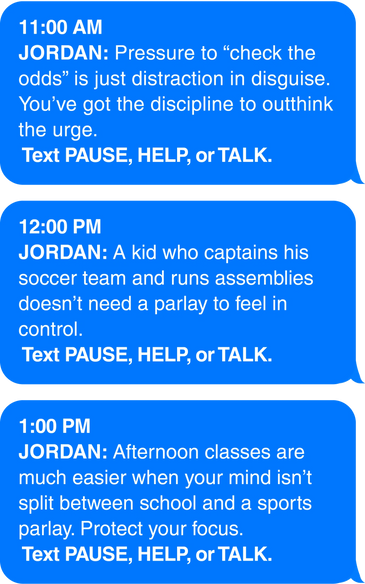
TeenBack sends teens short messages through an app, push notifications and, in some programs, text, email or voice.
At the bottom of many TeenBack messages, you may see words like:
- TALK
- SOS
These have specific meanings:
- TALK
When a teen uses TALK, TeenBack can prompt or connect a phone call to the parent or guardian phone number that has been stored for the account or agreed in the program. - SOS
When a teen uses SOS, TeenBack can connect them by phone to a live counselor at the 988 Suicide and Crisis Lifeline in the United States, or to a similar crisis line where 988 is not available.
Standard call or carrier charges may apply, depending on the phone plan. TeenBack does not charge extra for using TALK or SOS.
5. GEOFENCING AND LOCATION
Geofencing is optional. It is off by default.
If a parent or school turns geo fencing on:
- They choose high risk locations, like a vape shop, liquor store or gambling venue.
- TeenBack uses location signals to notice when a device enters or exits those zones.
- We do not keep a full map of everywhere a teen goes all day.
When a device enters a high risk zone:
- The teen can receive a support message in the app, by push, or by text.
- If the family has chosen it, a parent can receive a simple alert that a high risk zone was entered.
Geo fencing can be turned off at any time by the parent, school or, where allowed, by the teen.
6. WHO SEES WHAT: TEENS, PARENTS AND SCHOOLS
We are very clear about who sees what information.
- TEENS
Teens see their own messages, settings and any support resources we provide. We do not show them other teens’ data. - PARENTS AND GUARDIANS
Parents can see information that is described in their account or program, such as mirrored alerts, high level summaries and safety settings.
Parents do not see private, one to one messages that a teen sends in the app, unless both the teen and parent have clearly agreed to that option and it is allowed by law. - SCHOOLS AND DISTRICTS
Schools and districts see program level information, not private teen conversations.
This may include aggregate engagement, trends and risk themes across groups of students.
Schools do not see individual message content, unless a law requires it and the proper safeguards are in place.
7. AGE, CONSENT AND WHO CAN SIGN UP
TeenBack is designed for teens.
- Teens 13 and older may often sign up on their own, depending on local law.
- Younger teens may need a parent or school to create or approve the account.
- In school programs, the school or district may act as the consent authority, and TeenBack acts as a service provider.
If we ever learn that we collected data from a child who is too young to use TeenBack without the right consent, we will remove that account and its data as soon as possible.
8. YOUR CHOICES AND CONTROLS
You always have choices.
Teens, parents and schools can:
- Change how often messages are sent
- Change which topics are a focus
- Turn off optional features like mirrored alerts or geo fencing
- Ask to see what information we have
- Ask us to correct something that is wrong
- Ask us to delete an account and data, unless a law requires us to keep it for a period of time
You can:
- Adjust settings in the app
- Use built in options like STOP or PAUSE for text messages (if SMS is used)
- Email us at privacy@TeenBack.com for help with privacy questions or requests
9. SAFETY AND SECURITY
We use modern security tools to protect information.
- Data is encrypted when it moves and when it is stored.
- Only trained staff and service partners who need access to run TeenBack can see personal information, and they are bound by strict rules.
- We keep systems in professionally managed, security audited environments.
If we ever learn of a data incident that affects your information, we will follow the law and let affected families, schools and authorities know within required time frames.
10. QUESTIONS OR CONCERNS
If you are a teen, parent, guardian or school and have a question about privacy, you can contact:
TeenBack Privacy Office
Email: privacy@TeenBack.com
We take privacy and safety seriously. If something does not feel right, we want to hear about it.
TeenBack’s safety and sciences are built around a simple reality: the same device that exposes teens to gambling, vaping, and alcohol risk is also the most reliable channel for reaching them; the phone. Our AI platform uses a secure, evidence-informed system to deliver brief, hour-by-hour micro-interventions adding another layer to counseling or therapy. Messages are time-sensitive, age-aware, and behavior-focused.
The Engine Behind the Solution.
1. BEHAVIORAL TIMING MODEL
TeenBack aligns outreach with adolescent risk patterns documented in behavioral psychology. Teens don’t struggle randomly—patterns exist. We message when they need us most, not when it’s convenient for us.
- Uses research-based “high-risk hours” for adolescent impulsive behavior.
- Syncs message timing with known windows of cravings, urges, and digital activity.
- Reduces gaps where teens are most vulnerable: late evening, after school, weekends.
2. DEVELOPMENTALLY APPROPRIATE LANGUAGE
TeenBack’s language is engineered for adolescent cognitive development—not adults. It’s honest, grounding, and emotionally attuned to how teens actually process support.
- Calibrated to match adolescent cognitive and emotional processing levels.
- Avoids clinical language that teens tune out or interpret as judgment.
- Prioritizes grounding cues, simple phrasing, and emotionally safe tone.
3. MICRO INTERVENTIONS
Short, frequent, precisely-timed messages create micro-disruptions in harmful patterns. This mirrors successful behavioral-change models used in addiction prevention and habit reversal.
- Short, high-frequency prompts interrupt compulsive patterns in real time.
- Mirrors proven micro-habit research to shift behavior gradually and safely.
- Reinforces healthy neural patterns through repetition and timing.
4. TRIGGER-AWARE PERSONALIZATION
TeenBack adapts messaging to daily rhythms—weekday vs. weekend, school hours vs. downtime, late-night vulnerability vs. early-day clarity.
- Adjusts messages based on time, day, and likely environmental triggers.
- Incorporates behavioral context rather than relying on static schedules.
- Supports decision-making at the exact moment risk rises.
5. AGE AND SENSITIVITY CALIBRATION
A 13-year-old and a 17-year-old don’t think, feel, or react the same way. Our system never treats them as interchangeable.
- Adapts text tone and content for early teens versus older teens.
- Avoids content that may be too mature or too simplistic for a given age.
- Aligns with the developmental arc of emotional regulation.
6. INTEREST-BASED IDENTITY REINFORCEMENT
Addiction disconnects teens from their identity. We reconnect them—subtly, respectfully—by tying messages back to passions, interests, and motivations that addiction typically erodes.
- Uses self-reported hobbies and interests to strengthen positive identity.
- Reconnects teens with activities that counteract addictive tendencies.
- Encourages agency, pride, and non-addictive sources of dopamine.
7. LANGUAGE SAFETY FRAMEWORK
TeenBack uses a proprietary filter to ensure every message is supportive, non-triggering, and aligned with adolescent mental-health communication guidelines.
- Filters all messages through evidence-based youth communication standards.
- Avoids accidental reinforcement of addictive behavior or cravings.
- Removes shame language, pessimistic framing, or adult-centric messaging.
8. ESCALATION AND HUMAN REDIRECT
TeenBack is preventative—not a crisis hotline. When a teen signals distress beyond our lane, the system hands off instantly to real human support.
- Auto-redirects “HELP” or concerning keywords to human-run hotlines.
- Ensures AI does not attempt crisis intervention or clinical guidance.
- Follows established crisis-escalation practices used by national hotlines.
9. AI BOUNDARIES AND ETHICAL USE
Our system never imitates therapists, diagnoses conditions, or crosses into clinical territory. It’s tightly bound to prevention and emotional stabilization.
- Prohibits the system from simulating therapists, diagnosing, or treating.
- Keeps AI strictly in a supportive, preventative, behavior-reinforcing lane.
- Aligns with global ethical guidelines for youth mental health technology.
10. DATA MINIMIZATION AND PRIVACY-BY-DESIGN
TeenBack collects only what’s essential—nothing more. We intentionally limit our system’s power to ensure maximum safety.
- Collects only four required data points: name, age, phone, email.
- Stores no addiction history, behavior logs, or psychological profiles.
- Follows COPPA, FERPA, and GDPR youth-privacy principles end-to-end.
RESULT
TeenBack’s safety and science framework delivers what schools, parents, and teens need most: a stabilization layer that reaches teens before the moment becomes a mistake.
- A support system that steadies teens before addiction escalates.
- A preventative model built on timing, behavioral science, and safety.
- A platform trusted by schools, parents, and youth-health professionals.

DATA SOURCE AND TRANSPARENCYTeenBack’s global and U.S. statistics are compiled from verified health and behavioral studies published between 2018–2024 by organizations including the World Health Organization (WHO), Centers for Disease Control and Prevention (CDC), OECD, UNICEF, ESPAD (European School Survey Project on Alcohol and Other Drugs), and national health ministries.Percentages and time-based comparisons reflect directional trends confirmed across multiple public datasets and research journals. While country-specific metrics are rounded for clarity, all represent the most current, evidence-aligned youth behavior data available.
TeenBack is a preventive support platform and does not provide medical, psychiatric, or emergency services. Messages are for guidance only and are not a substitute for therapy, counseling, or professional treatment. If you or someone you know is in immediate danger, call 988 or your local emergency number. Use of TeenBack requires agreement to our Terms of Service and Privacy Policy. Minors under 16 require verified parental consent. Copyright © 2025 TeenBack - All Rights Reserved.
Powered by TeenBack